Spells & Chaos
Casting Magic
Magic isn't easy. To cast one of your spells, you pay a hit point cost and make a d20 check. The stat depends on your character concept and the specifics of the spell. Most often in the Dungeonverse, it will be INT, WIS, and sometimes CHA.
Tell the Referee what you are attempting. They may ask for details to decide the stat to check and how many HP you have to spend. If the Referee understands what you want to do, they will give you a fair number. You can always dial back the effects to lower the cost. The HP cost can never exceed your current hit points. If it is greater than your level, you have disadvantage on the check. You spend the HP before rolling.
- On a success, magic works as discussed.
- On a failure, it doesn't work. Unless you let Chaos come into play!
Note that critical rolls have additional consequences:
- On a natural 20, the Referee decides what goes wrong or picks a mishap.
- On a natural 1, you don’t lose any HP.
Specialist magic. You can allow characters with traits such as illusionist or pyromancer to avoid rolling with disadvantage when casting a spell with a cost higher than their level. However, being specialised means lacking certain knowledge: a pyromancer would get disadvantage to know about water magic, and wouldn’t be able to learn an ice based spell at all.
A basic spell (cost 1) takes a full turn to cast. It is instantaneous, targets one creature at short range, deals or heals 1 damage, and has an inconsequential yet possibly entertaining effect. Increase the cost by 1 to 5 points for each:
- generic wording: for example, any use of a spell simply called Necromancy should add at least 2
- instant casting time
- long range, extra targets, or large area or effect
- damage or healing (from a single d6 to d10 per character level)
- target with more HD than the caster has levels
- spell duration (one turn, minute, hour, day, etc. per character level)
- practical effects (charm, phantasms, summoning, scrying, etc.)
You can also reduce the spell cost if it takes more time to cast, requires rare or expensive ingredients, or can only be completed in a temple or lab; remember:
- do not waste everyone’s time counting beans
- the Referee will not explain what’s going on; magic is fickle and weird
The Chaos Risk Die
The Chaos Risk Die represents the stability of magic in the area. It normally starts at Δ12, but some places and situations may have a lower Δ. If you fail your spell check but still want something to happen, roll the Chaos Risk Die and let magic do its thing. Be prepared for some interesting results.
| Spell mishap (chaos Δ) |
|---|
| 1. Power Surge. No magic happens but you regain the HP lost from the spell. |
| 2. Mistake. The effect is reversed or dramatically altered. |
| 3. Mutation. Your magic works, but leaves you with a scar, deformity, or oddity. |
| 4. Erasure. The magic works but you forget the spell until you sleep a full night. |
| 5. Drain. Lose points in a random stat equal to the HP cost, recover 1 point/day. |
| 6. Pyrotechnics. Loud, flashy and mostly harmless. Unless something catches fire! |
| 7. Weak Spell. Effects, area, number of targets, etc. are halved. |
| 8. Lack of Control. Your magic has a negative and annoying side effect. |
| 9. Power Leak. The magic works if you pay the HP cost again. |
| 10. Delayed Action. The magic takes effect... d4 turns from now. |
| 11. Bad Aim. The spell affects another target of your choice. |
| 12. BÄM! Double the effect, number of targets, or area of the spell. |
Depending on your setting, the Chaos Δ may be the same for everyone or distinct for different types of magic (representing the gods’ interest in mortals, the psychic maelstrom, or whatever cosmic force is present in your setting). You can even design your own table for each flavour of magic or for weird locations.
When a Risk Die fizzles, magic simply doesn’t work on a failed check. Chaos Δs are refreshed at the Referee’s discretion, depending of what you do, where you go and how much magic you cast.
Finding spells. Characters can research new spells when they level up, but it is always fun to find magicks while adventuring (and it provides an opportunity to use all the wondrous spellbooks out there). Learning a spell from a scroll or dead sorcerer's grimoire should require materials (payable in electrum at least) and a few quiet days.
Foci, Reagents & Magic Materials
To alleviate the cost of magic, most spellcasters and miracle workers carry a bag of disgusting reagents or a focus such as a wand, orb, psionic gem or holy symbol. It is a resource (with an associated Δ) to draw mystic energy from. Alternatively (and optionally), some casters draw on their Faith Δ.
Roll your reagent Risk Die to get extra points for paying HP costs. Just like your Armour Risk Die, you only roll this Δ once per fight or situation, when casting your first spell. The Referee decides if you should roll this Δ before or after the spell’s stat check.
Faith
The Faith equipment table (p.10) is mostly useful to characters with magical training. A character with Faith cannot use a focus or magic reagents to offset casting HP costs: they use their Faith Δ instead. Recovering or improving Faith needs time, dedication (like performing duties for the clergy), and sometimes tithes (with costs on par with other magic reagents). Faith comes with hierarchy, code of conduct, and more annoyances, but has some optional perks:
- Roll Faith Δ to get advantage on a roll for an action in line with the religion
- Spend an hour in prayer and heal a number of hit points equal to the result of the Faith Δ roll
- If you are unarmoured, you can use the Faith Δ to absorb damage You can step up one Faith Risk Die by taking Magic training again at level up.
Magical Items
In Macchiato Monsters, each permanent item should have a unique power, name or reputation. The short sword Hillpiercer, which gives its wearer the capacity to see through a metre of stone or earth is more interesting than a simple +1 blade. Some weapons might have an improved damage die, or give advantage to a non combat related check. A suit of magical armour can have better Δ, or give advantage to the roll. A magical shield can completely negate the damage from an additional attack before it is splintered.
Crafting Magical Items
To enchant an object, spend a week in a lab and make an INT check. On a critical success, the item is sentient. On a critical failure, you created a cursed item. If successful, roll your Coin Δ: gold for consumables, platinum for permanent items, mythium for powerful artefacts. On a 1-3 your Coin Δ is stepped down, like normal.
Depending on the result of the coin roll, the item has the following Risk Dice:
- 1-3: the item is single use
- 4-5: the item has Δ4 uses
- 6-7: the item has Δ6 uses
- 8-9: the item has Δ8 uses
- 10-11: the item has Δ10 uses
- 12: the item has Δ12 uses
The Referee may ask you to spend as many hit points as the Δ's result.
Drugs and Intoxication
When you consume a drug, get Intoxication Δ4. You get the benefits and drawbacks of the drug for an hour. Step up the die if you use it again within the hour. At the end of the hour, roll your intoxication Δ. If the die fizzles, your sober up and you cannot use the drug again in the same day. Some examples:
| Drug | Upsides | Downsides |
|---|---|---|
| Berserker chew | Advantage on intimidation checks | Bad breath |
| Black Death Lotus | Advantage on Necromancy and undead control spells | Disadvantage on CHA checks |
| Crimson Coffee | Advantage on resisting sleep and staying focused | Disadvantage on HD rolls to heal overnight |
| Freeboter’s Rum | Advantage on morale rolls and resisting fear | Disadvantage on DEX checks |
| Ice Peryton Ale | Drunk’s armour Δ4 | Pressing need to pee, always at the worst moment |
| Oracle’s Poison | The drug gives you a vision | When assuming, check CON to avoid taking d4 damage |
Addiction. When you sober up and you want to use again in the same day, get Addiction Δ4 and some sign of your abuse. Roll your addiction when you use again: on the maximum result, step the die up and get another sign or drawback (Referee’s choice). If you roll a 12, you die.
An Example of Magic at Play
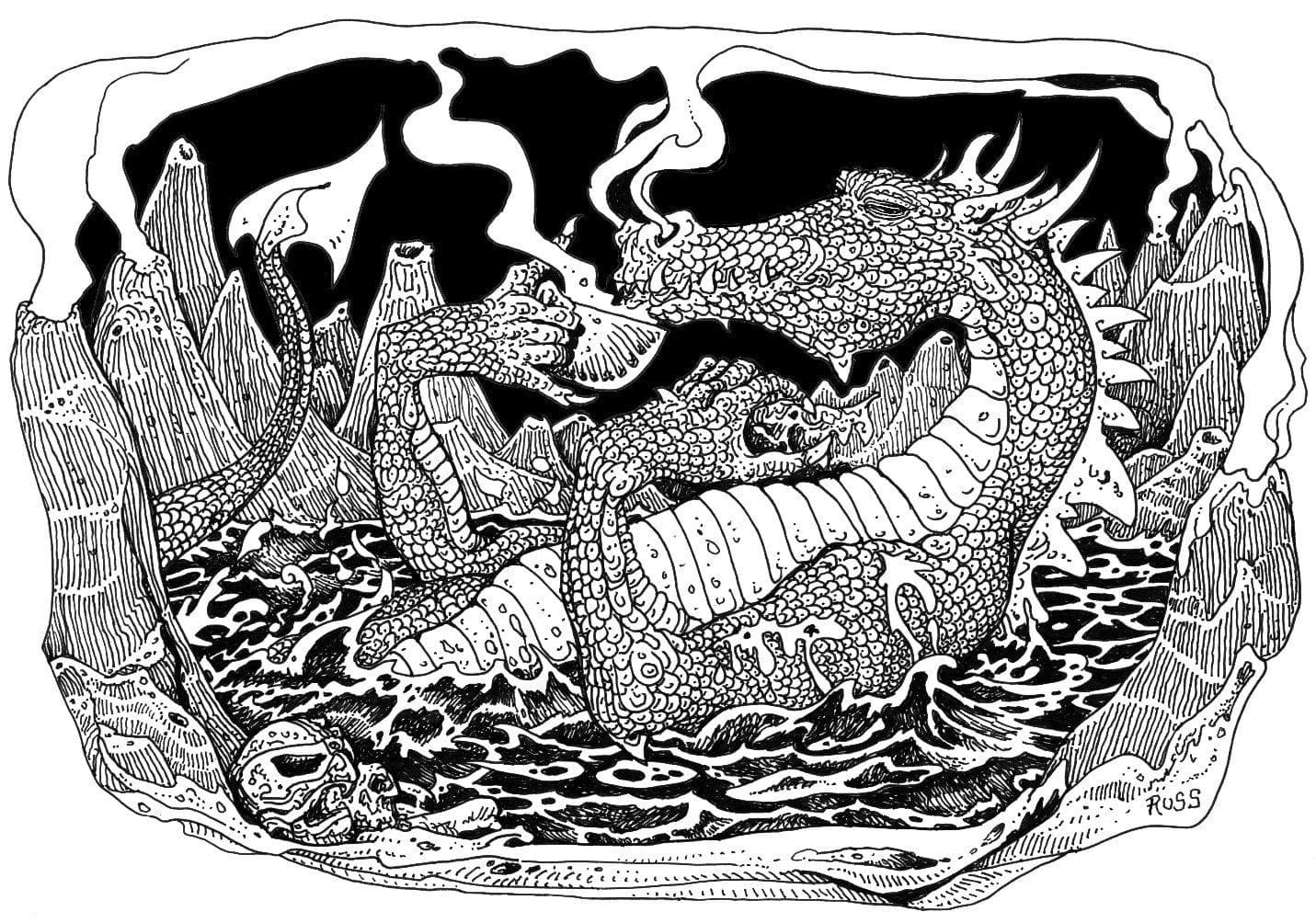
Edith is refereeing for Opto the psionic elf-bot and Mazey the explorer, both first level characters. They have ventured in the Concrete Ruins and disturbed a nest of three magma bats. Edith describes the situation: Mazey is attacked by one creature and Opto by two. Mazey's player says she wants to jump back and shoot the critter with her heavy pistol. It is a DEX check, with disadvantage since magma bats are 2 HD creatures and Mazey only has 1 HD. Unfortunately, the roll is a natural 20! Instead of doubling the damage, Edith rules that the bat bites normally (d6 for 4 damage) and starts melting the explorer's hand cannon (she decides that it drops from d8 damage to d6). Mazey's player rolls 3 for her leather armour, so she takes 1 damage. Her armour is gone until she gets a few minutes rest, and since she rolled a 3, the armour die is stepped down to Δ6. It will need some mending. Edith describes how the hellish beast is clinging to the gun, biting straight through Mazey's burnt glove. Not the best start.
The Referee turns to Opto's player: one monster has landed at his feet while the other hovers above his head, its snout dripping lava. Opto wants to use his Biohazard Field spell to insulate himself from the heat. It's a new use for this spell, so Edith proposes Δ8 extra armour for a single turn, at a cost of 3 HP. After all, Biohazard Field is pretty vague wording. The cost is over Optos's level, so the roll is at a disadvantage – something that would have happened anyway since the elf-bot has to fend off monsters with more HD than he has. The roll is a miss, meaning Opto is going to take damage from both magma bats, in addition of the spell's cost. To the player, it is worth taking the risk to roll the chaos Risk Die (currently a Δ12), instead of forgoing the effect entirely. He gets a 1: a power surge. The spell doesn't work and the chaos die is stepped down to Δ10, but at least Opto recovers his lost HP. The total damage from the monsters' attacks is 7, minus 5 for Opto's Δ6 armour.
With both characters injured and no armour left, the players agree that a hasty retreat is in order. Edith, being a heartless Referee, explains it's not going to be that easy. Mazey and Opto have to run and jump among the rubble, while their pursuers are airborne: a DEX check with disadvantage. But Mazey's player has a plan. She asks Edith is she knows of any way she could distract magma bats. Edith allows a rumour check with advantage (Mazey having the explorer trait). It's a success, and Mazey's player states that the creatures like to eat metal, and are particularly fond of lead... which is why they prey on wellarmed adventurers. The Referee laughs and agrees. She rules that if both characters dump all their bullets to the ground, they can get advantage on their DEX checks. Both players jump on the chance. The dice roll: Mazey makes it, but Opto does not. It is now up to Mazey’s player to decide if she wants to turn back and help when the bats catch up with her friend, or keep running for her life. An adventurer's career is filled with hard choices.
THREE SAMPLE SPELLS
Thuvia's Rain of Blades
Thuvia the Spearceress knows a spell called Animate Steel. She has a quiver of javelins that she wants to magically hurl at a group of bugbears a few metres away. The Referee asks a couple of questions and they agree on the following details: the spell is instantaneous, and does the same damage as javelins (d6) on a handful of targets.
Animate Steel is pretty broad, so the Referee decides that this use costs 3 hit points, and also maybe some ammo (the javelins' Δ has to be rolled). Thuvia wants her missiles to avoid her friends already in mêlée, but the Referee wants an extra 2 HP for that. That’s too expensive for her, so any ally in the target area has to check their DEX to avoid taking damage.
Thuvia's player jots this down and calls this specific use of her spell Thuvia's Rain of Blades. She now has a template for similar attacks. It should be easy for the Referee to give her a fair cost by comparison.
Melt Them Faces!
Belek, the goblin warlock, wants to cast his Melt Them Faces! spell to melt a merchant's face. But instead of just doing damage as he has been so far, his idea is to disfigure and humiliate the merchant who cheated him. This use is close to the wording of the spell, so the Referee asks for only 2 HP, plus more for duration (Belek settles for a day at the cost of 2 HP) and inevitability (if Belek does not spend an extra hit point, his target can resist the spell with a WIS check). Costing 5 hit points, it's an expensive revenge, but Belek is that kind of goblin.
Hearing the Wise Wyrm's Counsel
Lilia the Conjuratrix is in need of advice. With her spell Summon Dragonkin, she wants to contact one of the legendary Wise Wyrms. Talking to an ancient god lost in a nightmare dimension is no small feat, so the Referee asks for a base spell cost of 8 HP, with each additional question costing an extra 2.
But Lilia is in no great hurry. The Referee rules a week's research and some rare ingredients lower the base cost to 6 HP. Of course, if she traveled to the fabled Temple of Otherworldly Perception and made a suitable offering, she would only have to spend 4 HP for a 10-minute conversation.
Lilia gathers her books and warns her adventurer friends that she has a little trip planned for them.
Your world, your magic. This is how I would handle these spells and players. Your Refereeing mileage will vary according to your tastes and the style of magic you want to build for your setting. My two rules: follow your gut and stay consistent.